In 2017, Staupell joined Business Networking International, a networking association for small businesses to build each other up through referral marketing. Our goal was to meet and share our expertise with small businesses in Upstate New York, where we’re headquartered. At the same time, I met someone for the second time at Fundraising Day New York, sponsored by AFP’s New York chapter. When I asked him outright what services would interest him, he said, “I need to write our case for support.”
My immediate suggestion was to identify those words and phrases that would resonate best with his audience. In other words, I wanted to reach through his organization’s social media accounts to find what words and phrases got the largest number of positive reactions (such as “likes” on the organization’s Facebook posts). And so we launched a project, borrowing the web pages of two of our small business friends: Gabriel Colella, transformational teacher; and Snug Planet, environmental services company.
Using these two companies’ websites and Facebook pages as our guinea pigs, we built illustrations of themes from the web pages vs. themes from Facebook that resonated best with each company’s audience. This blog post describes the project’s results.
Sample Service Provider: The Law of Reflections Transformational Healing Service
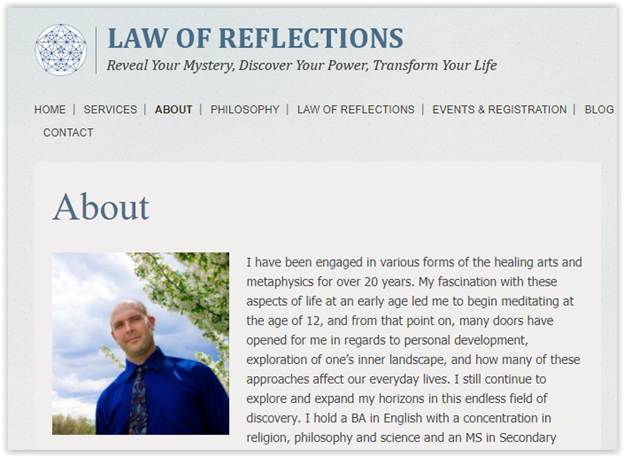
Gabriel Colella offers a unique service involved with helping those who have not had success with therapy or other emotional services, and are still hoping to find a service that will help them recover from trauma or deal with stress. His business is hard to categorize because he’s not a psychotherapist or a reiki master; his work is new and unique. Here’s a snippet from his website, “Law of Reflections”.
The Law of Reflections website is text heavy, since the topic does not lend itself well to photos of happy customers. We copied down all of the text from the site (we had the owners’ permission for both companies), split out the sentences into single words, and built this word cloud to note themes. The larger the word, the more frequently it appears in the web page’s text. The different colors are only for ease of viewing the words.
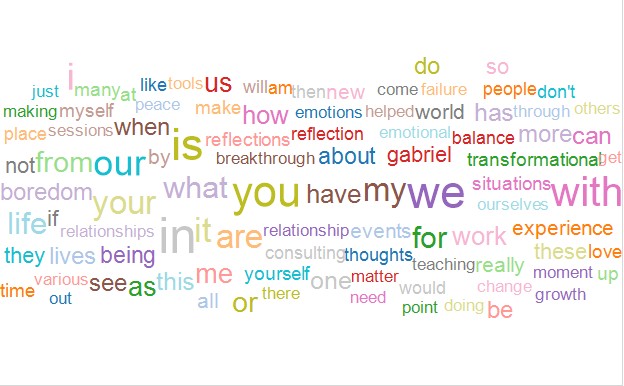
Notice that some pronouns are prominent, with “reflections,” “thoughts,” and “matter” in the second level of frequency. These words make sense on a web page designed to differentiate Gabriel’s practice from a larger company or a therapy center – his services are personal and reach beyond ordinary therapy topics.
But are web page visitors reading the web page description and thinking, “Hey! That feels like me.” Or does some other collection of words and phrases connect better to Gabriel’s audience?
To discern that, we downloaded the past year’s worth of posts from the Law of Reflections Facebook page and labeled each post with a theme. Here are the ”likes” and “loves” for the top themes:
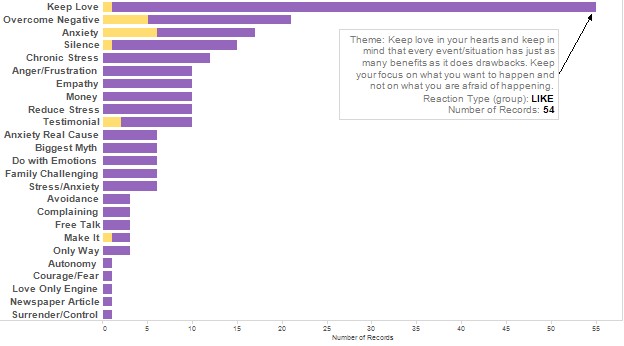
So, we see that Facebook posts with themes around love, stress, and anxiety were “liked” by the Facebook page’s audience. Using this business intelligence, Gabriel will be revamping his web page to include concrete, personal themes.
Case Study Two: Business with Products and Services
Snug Planet is an environmental services firm focused on improving the efficiency of homes, especially in relation to insulation, heat pumps, and other devices that reduce or eliminate the use of fossil fuels. Services also include energy audits. Here is a snippet from this company’s website:
Snug’s website is more complex for your average scraper, offering several sub-pages, photos, and illustrations. Our data acquisition associate, Tricia Tauzin (include her e-mail), scraped the site’s text for parsing. Here is that resulting word cloud.
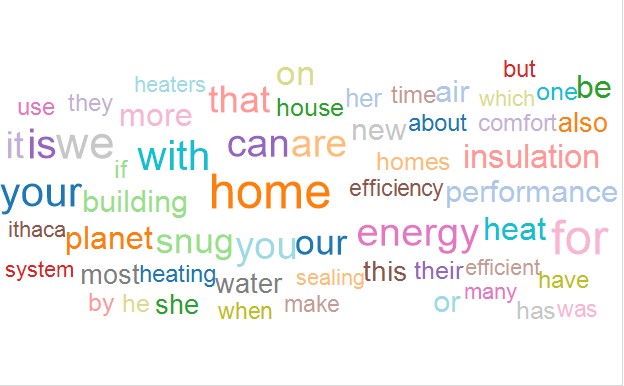
This word cloud makes perfect sense: Efficiency, home, energy, heat, and Ithaca should be prominent themes on the website of a company that endeavors to efficiently save heat and energy in the homes of Ithacans. But what Facebook post themes garnered the most reactions? Here is that table.
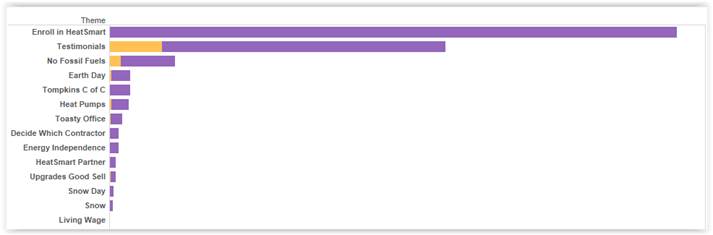
The “Enroll in HeatSmart” post contained a link to sign up to be involved in an initiative that seeks to remove all fossil fuel use in homes in Tompkins County, NY. Imagine having no propane, gas, or oil on your property – that’s the effort. This project overwhelmingly won the “Likes” contest among a year’s worth of Snug Planet Facebook posts.
Note that second is the testimonials posts. Indeed, that band of gold tells us that the testimonials garnered more “Loves” than the other posts.
Jon and Elizabeth Harrod, owners of Snug Planet, are thinking about concrete information, links, and other tools for website visitors to use to become engaged in the Snug Planet mission.
For this company, we also ran a social network test, usng the NodeXL product. We found that “Enroll in HeatSmart” also attracted the company’s biggest raving fans, as illustrated below.
Lower righthand corner: This one person has several Facebook friends, and liked the “Enroll in HeatSmart” post.
The lines on this network graph show the theme that was shared from person to person. You’ll notice that the “Enroll in HeatSmart” theme takes up most of the graph, especially among the most connected.
The different colors represent NodeXL’s clustering of the people mapped here, and you’ll notice that the blue and butterscotch groups both show people with several friends, some of whom have several friends (see the circle on the graph). The non-colored connections, at the upper righthand side of the graph, represent a variety of other themes, like “Energy Independence” and “No Fossil Fuels”.
Remember that “No Fossil Fuels” is one of the main goals of HeatSmart (link: http://www.solartompkins.org/), but giving the reader something to do inspired more engagement than just talking about the concept.
We also examined Snug’s biggest fan, and biggest connector. For illustration, we marked his connections in red, below:
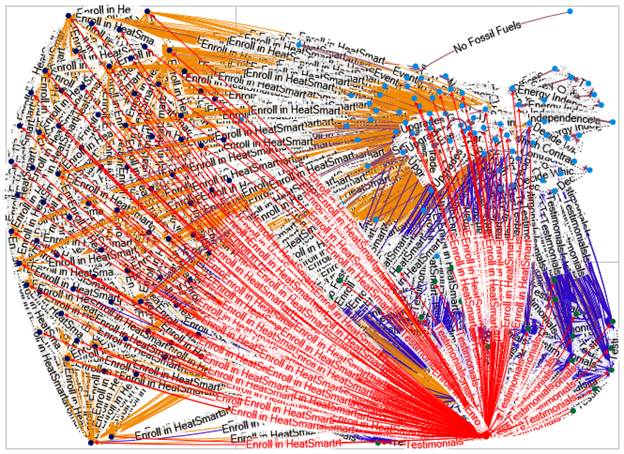
This one person has connections to so many other people that he takes up at least a third of the lines. We shared his Facebook handle with the Snug team, who will follow up.
How to Use These Results
We crunched through 3 exercises on two different company sites, bringing back a variety of graphs to look at. But now, what?
Here are some of the uses of a project like this:
- Parsing out words (and 2-, 3-, and 4-word phrases) on an organization’s website shows whether anything is repetitive and whether the organization’s mission is shared clearly.
- Comparing web page language to language that an organization’s audience relates to allows for adjustments to all the organization’s communications. “Transformational” becomes “Reduce Stress” and “Energy Independence” becomes “Estimate Your Costs Here”.
- Find an organization’s connectors and mavens is key to building the referral network. Imagine that the huge fan of Snug Planet, shown above in red, is a donor who just gave her first $1,000, and your research team builds a similar network graph of your non-profit’s Facebook or Twitter fan pages. You’d have your next best volunteer.
Wrap Up
As we walked through this exercise with our kind guinea pigs, I did reflect back on the harried expression of my Fundraising Day New York friend, I have to wonder what other sentences can be gleaned from his audience to find the right phrases to connect with them. Does he have e-mails that his prospects wrote to him? Or any access to survey data? If he did, a project like this for him would end with a case for support that touches his audience’s heart deeply.